- tmrw
- Posts
- The Illusion of Control
The Illusion of Control
Something is changing in how people work on their money, and most people do not realize it is happening to them. The habit is forming fast: you read a headline that makes you anxious, you open an AI tool, you type your fear into a box, you get a confident and well-organized answer, you feel better, and you move on with your day feeling like you did something productive. That loop is running millions of times a day. And it is creating an illusion.

Tom Stadum
April 23, 2026 • Read Time: 3 minutes

This is tmrw — a weekly note on money, decisions, and what tends to matter over time.


Habits are forming. Fast.
Something is changing in how people work on their money. It happened quietly, and most people don't realize it's happening to them.
You read a headline about AI replacing jobs. You open ChatGPT. You type your fear into a box. You get a confident, well-organized answer. You feel better. You close the app and move on with your day feeling like you did something productive with that anxiety.
That loop is running millions of times a day. And I want to talk about what is actually happening inside it.
We have been watching this shift inside Fjell. Clients are coming in having already worked through financial strategies using AI, and more often than not, the ideas are technically sound. What changes is the nature of the meeting. The tool gave them the what. But the when, the why, and what it actually means for their future? That only resolves when someone knows the whole picture.
Here is what most people don't understand about how these systems work.
When you type your financial situation into an AI, your words travel somewhere. They move through infrastructure: server farms, cloud grids, knowledge layers built from hundreds of billions of data points. The model processes your input alongside the inputs of every other person who has ever asked something similar. It finds the shape of your question. It returns an answer calibrated to the average.
Not to you. To the average.
The model does not know your business equity. It does not know your tax situation, your succession plan, your marriage, your health, your timeline, or what you actually want your life to look like at 68. It knows your words. It knows the aggregate pattern of everyone who has ever typed something that resembles what you typed.
You feel like you got advice. You got a generalization that fits your question well enough to feel personal.
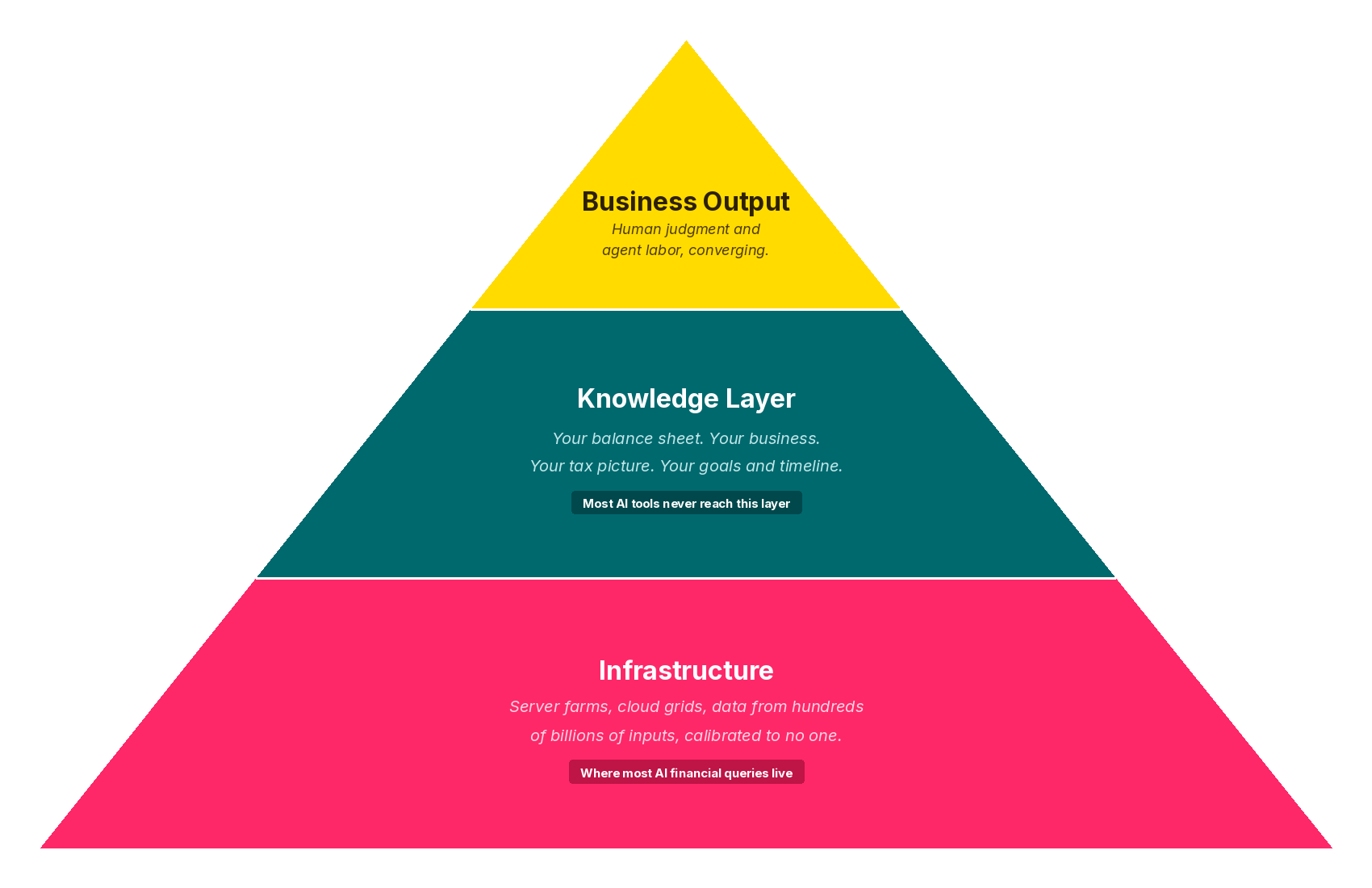
This diagram is something I shared with clients at our last quarterly review. Look at the layers. Infrastructure at the bottom. Knowledge layer in the middle. Business output at the top, where human and agent labor converge. Most people accessing AI for financial decisions are touching the bottom layer only. The knowledge layer, the one that would actually know their life, doesn't exist for them. And they can't tell the difference, because the output sounds so good.
That gap is the illusion.
This year, I have been writing about what is happening at the macro level. The tariffs. The AI repricing. The employment anxiety that is sitting underneath the surface of what feels like a calm market.
But I want to get down to the layer that actually matters: how you work on your money, day to day, in a world that is changing faster than anyone predicted.
Three things drive your financial life. Markets. Life events. Behavior. You control exactly one of them.
The markets do what the markets do. Life arrives on its own schedule. Behavior: how you save, how you spend, how you decide, who you trust with your financial life. That is yours. Fully and completely yours.
The illusion of control is spending your energy on the first two and calling it work.
And here is the 2026 version of that illusion: opening an app, typing your fears into a box, and walking away feeling informed. You were not advised. You were processed. The machine got smarter about you as a data point. You got an answer built for the middle of the bell curve.
The advisor who helps you build your own knowledge layer, with your actual balance sheet, your business, your tax picture, your goals, is not competing with AI. They are using it the way it was designed to be used. The person typing alone into a free tool gets a tool that uses them.
You cannot control what AI does to the labor market. You cannot control what the market does next quarter. You cannot control the legislation coming out of Washington or the price of oil.
What you can control is whether the people and systems working on your financial life actually know you. Or just know the shape of you.
Your net worth is a story of future consequences. The consequences that matter most are not the ones the market writes. They are the ones you write.
Tom

If you’d like to talk through how this applies to your own financial life, you can learn more about our work at Fjell Capital here.
And if you found this edition useful, let me in the poll below or reply with a quick note—I read every response.
More next week.

How helpful was this week’s edition?Comment after you submit. Your feedback helps shape what I write in future editions. |

 |  |  |



